Who's Tracking You?
Just recently I heard a story on Fresh Air, a radio show on public radio, about companies that track your web surfing habits and sell them to ad agencies. It was a fascinating story, and a chilling one. There are companies making tons of money off of your browsing habits. By tracking where you go, ad companies can advertise products based on your specific habits. While this is nothing new, and many argue that at times it makes things like Internet searches easier, it can be a little creepy. The guest on the show, Julia Angwin from the Wall Street Journal, told a story about looking at shoes online and then having the shoes appear in ads all over the pages she browsed on the web. She finally broke down and bought the shoes.
Like most people I know, I do a lot of web surfing, and I'm not comfortable with 3rd parties having access to my browsing habits. Julia shared a resource, Abine, which is a browser add-on that encrypts your information, scrambles your email address and blocks 3rd parties from accessing your information. The coolest thing it does is that it pops up a little window in the corner of your browser when you go to a site telling you how many cookies have been placed on your computer by the site, and whether there are any ad networks or tracking sites in use. You can then block them with the click of a button. I have been using Abine for a day now and just to give you an idea of what I've learned about different sites, here is what came up when I went to Best Buy's website, which I have spent a lot of time on recently while searching for a washing machine.  If you are someone who is concerned about their browsing privacy, check out Abine to see what it can do for you. I also suggest that you read or listen to the story on Fresh Air to learn more about what companies are tracking and how. Crowdsourcing is Dead. Or does it have a new face? Quoting a recent Pew study that the number of bloggers in the 18-24 year old range has declined by half from 2006 to 2009, the authors argue that this is evidence that "many of them would rather watch funny videos of kittens or shop for cheap airfares than contribute to the greater good." They acknowledge that there has been a large shift to Twitter, but then state that, with "50 million tweets per day...as many as 90 percent of tweets come from 10 percent of its users according to a 2009 Harvard study." In addition, the authors describe a decrease in commenting by Internet users along with ploys that various sites have introduced to increase interactivity by users. I agree with the authors that at the dawn of the interactive web there was a feeling that it was a great democratizing force and that it allowed for everyone's voice to be heard, so people were excited to contribute. However, they claim that 'ennui' is the reason why interactivity on the web has decreased. There are a few factors at play here. Cliff Lampe's insight, as quoted in the article, that there are more sites competing for our attention plays a huge role. With so many places to have our voice heard, contributors are stretched thinner than ever. However, the decrease in the number of bloggers in that age range just means that most bloggers are older, professional bloggers and that perhaps (gasp!) the format that people use to express ideas and opinions might be evolving or that people can't be forced to comment on content that is irrelevant or poorly written. I have seen 3 or more pages of comments on articles about charter schools or government policy, never mind the pages of mindless comments on YouTube videos. As for crowdsourcing, I have crowdsourced ideas at least a dozen times just this month. I had 88 responses to my survey on technology tools people planned on using during the first week of school. South by Southwest crowdsources its panelist proposals each year and every week the #edchat discussion topic is decided by an online poll. A couple of other things came to mind. Should we be worried about the idea that we will return to being web content consumers? We should teaching our students how to harness the power of the interactive web to make sure it survives, grows and evolves. Our students hold the future of the web in their hands. We need to explicitly teach our students how to use the Internet for more than cute kitty videos and shopping and we need to accept the fact that the web is a fluid, constantly evolving organism that is only in its infancy. The web that our students will use when they are adults is something we can only imagine in our wildest dreams. They need to be an integral part of its future. There are many other details in the article to reflect on, and I suggest you give it a read, even if you don't agree with its slant or conclusions. Feel free to leave any comments on the article or on my musings below. photo from Hannes Treichl on Flickr Vote for 2 Great South by Southwest (SXSW) Panels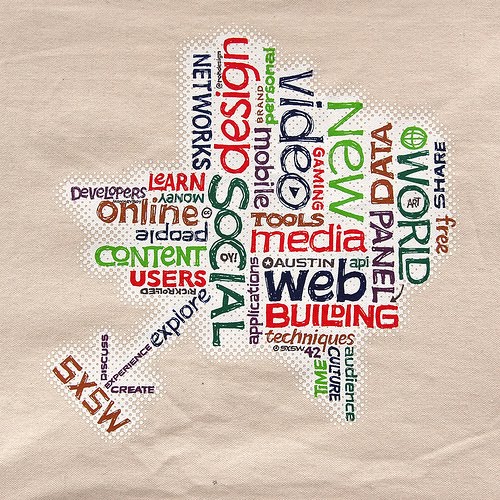 I have been honored to be included in two education panel proposals for the South by Southwest (SXSW) music, film and social media event held every year in Austin, TX. It draws thousands of people from all over the country and lasts an entire week. The two panels are chock full of talented, innovative people who live and breathe education and are dedicated to doing what's best for students. Feel free to pick the one you like better or vote for both! Panel 1: The Emerging Role of Social Media in Education Panelists: Richard Byrne, Steven Anderson, Kyle Pace and myself plus a moderator TBD Panel 2: Education in the 21st Century Panelists: Joe Bower, Chris Lehmann, Shelly Blake-Plock and myself plus Aparna Vashisht as moderator To vote, you will need to create a free Panel Picker account, which only takes a few minutes. SXSW states that they do not use your email address to send information or emails, so don't worry about getting a million emails from them. Voting ends Friday, August 27th and these crowdsourced votes count for 30% of the total votes! Thanks for your help! photo courtesy of Mike Rohde on Flickr I Miss My Old Brain I recently began reading The Shallows: What the Internet is Doing to Our Brains by Nicholas Carr. I first saw him on The Colbert Report and was intrigued by his interview. I have only read the prologue, but already I am hooked. Even when I was away from my computer, I yearned to check email, click links, do some Googling. I wanted to be connected. Just as Microsoft Word had changed me into a flesh-and-blood word processor, the Internet, I sensed, was turning me into something like a high-speed data-processing machine, human HAL. I missed my old brain.Carr's story struck such a chord with me that I made it a mission to get my old brain back. I used to sit and lose myself in 300 page novels. I've never really been good at getting work done in front of the TV or if there is music with words playing in the background. I get to work at 7:20 am every morning so that I can have an hour to myself uninterrupted in my room before the day starts. So why am I kidding myself that I'm doing my best work with TweetDeck running, my email open and a tab open for Facebook (not to mention countless other tabs and windows)? These last few days I have done my best to only check my email on my phone if I feel the urge. This keeps me from getting sucked into the computer. I spent today catching up on my Newsweek magazines, helping my friend with some little tasks for her jewelry-making company and rather than take the train home I walked the 20 blocks. It felt wonderful. It's almost as if every minute I spend off the computer makes it that much easier to close the lid. It's a weird revelation for someone who dedicates so much time to using technology for her own learning and spends so much time and energy learning new ways that technology can inspire and motivate students while allowing them to take control of their own learning. Call me 'old school,' but I think that it is important that we teach students how to focus on one thing at a time. I think our students need to be aware of their own multitasking and they need to be taught how to take measures to balance the skimming and shallow activities that they do on the Internet with deeper, uninterrupted activities. In my experience, when I spend hours multitasking on the computer or spend days at a time sitting at the computer I feel scatterbrained and unfocused. I find it hard to start tasks around the house or sit and read my Newsweek or whatever book I have on my Kindle at the time. Today I felt focused, refreshed and, well, alive. I recently read a wonderful New York Times article entitled I Tweet Therefore I Am. In the article, the author describes a touching moment with her daughter which she has an urge to tweet out to her friends. She continues to eloquently describe how Twitter plays into our psyche and our self-image. Twitter has definitely changed the way I experience life. Small observations and experiences become tweets in my head almost unconsciously. For example, I am thinking of a tweet right now while I watch The Daily Show about how having Will Ferrell and Jon Stewart at the dinner table would be the best night of my life. I am certain that the Internet is changing the way we think and experience our day to day lives. We need to be conscious of this and make sure that we don't mistake efficiency and the ability to absorb large amounts of information for careful reading and thoughtful reflection on what we are absorbing. I am also certain that the Internet has been an invaluable resource for me, especially over the past year. The information and resources I have accumulated that help me be a better teacher, the relationships that I have fostered, the connections I have made, the dialogues and debates I have had are priceless. Granted, I have been forced to learn how to manage all of this information through various tools like Google Reader and Diigo. I have also been forced to learn how to manage my online relationships through tools like TweetDeck. The result? From time to time I have an information overload or a feeling that I can't keep up with all of the conversations flying by. I start to find myself clicking around from tab to tab or tweet to tweet mindlessly. I miss my old brain. photo courtesy of Dimi15 on Flickr My Call to Educators for Leadership Day Last year I participated in Scott Mcleod's Leadership Day project with an overview of the NETS for Administrators that I felt were most important and a video of some of my campers talking about technology in their inner city schools. A year later I have grown exponentially as a teacher and as a person as a result of being connected with educators and Administrators all over the world. I call some of these Administrators colleagues. This has greatly changed my perspective on what an Administrator's role is as well as what the challenges are of being an Administrator. I have also come to realize that Leader and Administrator do not always mean the same thing. I have met many Leaders who do not run schools or districts (and I have met Administrators that were not necessarily Leaders). I thought about this while reading Jon Becker's Leadership Day post. In his post he lists award winners in various education organizations. These are highly regarded thinkers in education who have a lot of influence on policy and practice. Powerful thinkers that I had never heard of. He called on these organizations and individuals to step up their game by becoming more transparent about what they do and say through social media like blogs. I would say that we who consider ourselves leaders or aspire to be education leaders who are 'in the trenches' need to do the same. How many of the people on that list know the people I consider leaders? Social media has connected me with educators all over the globe as well as thinkers and doers like Alfie Kohn, Howard Rheingold and Diane Ravitch. Granted, there are those that would argue that these are famous names, but not great thinkers in education. However, they are famous and respected by many. So it seems the logical next step is for these award winning thinkers to join the online community. We want our president to be transparent. We rally for more a more open government. Why are we not rallying for a more open conversation between the educational thinkers, the doers, the leaders, the people in the trenches, the parents, the students, the teachers? The challenge may fall back to the old 'us vs. them' situation. But isn't that why we love social media so much? It tends to tear down those titles and walls, allowing for a free flow of ideas. I can tweet Barack Obama (though Lord knows who's reading it!) Earlier in the year my friends were debating back and forth with Governor Chris Christie on Twitter about the education reforms he was pushing in New Jersey (again, who knows who they were really tweeting with!). Let's bring more people into the conversation. As Jon suggests, look up some of the thinkers on that list. Start blogging about what you find or read. Start talking about their ideas in the context of what you do on a daily basis. "The squeaky wheel gets the grease" as they say. People are always interested when they are being talked about! "But who cares what I have to say? I'm not a true Leader in education," you say? If you are a teacher who finds that others tend to listen to you when you speak, you are a Leader. If you are an administrator who works alongside his or her staff and has a true vision for your school, you are a Leader. Bring attention to what you are doing in your school, your classroom or your district through blogs, videos, press and even direct contact. Make it so that the people on Jon's lists know who you are just like you know who they are. As Leaders in your respective worlds, you are doing a disservice to your individual causes by not connecting your two worlds. image courtesy of dunechaser on flickr
Subscribe to:
Posts (Atom)
Creative Commons License Philly Teacher by Mary Beth Hertz is licensed under a Creative Commons Attribution-Noncommercial-No Derivative Works 3.0 United States License. Subscribe To
 Posts
All Comments My Visitors
About Me
Edcamp Philly Organizer
Learning Today Blogger of the Week
I'm a Diigo Educator
I Heart Storybird
|